A few notes can give a house loop its whole character. Learn the chord shape, choose a bass route, then use rhythm and voicing to make it move.
These deep house chord progressions explore minor ninths, altered dominants, chromatic movement and a borrowed minor-iv ending. Each idea includes a MIDI note map, a practical exercise and an excerpt from the original lesson, so you can connect the theory to an actual sound.
You can build every example in a piano roll or play it on a keyboard. Start with sustained chords and a plain piano or electric piano. Once the notes work, try shorter stabs, a bass part and a groove. The same harmonic tools can also feed jazz-funk and other electronic productions; the sound and rhythm help decide where they belong.
Adapted from Niko Kotoulas’s complete lesson. The video title says seven, but it develops six main progression families plus variations. All six are covered here. Historical giveaway announcements are excluded.
Choose a starting point
| Progression | What to listen for |
|---|---|
| Am9–E7alt | Tension returning to A minor |
| Am7–B♭m7–Bm7–Cm7 | One minor-seventh shape moving by semitones |
| A–D–G–C | Open upper shapes over a fourth-based bass line |
| Cmaj9–D♭maj9–Cmaj9–B♭maj9 | Major-ninth colour around a C centre |
| Cmaj7–E♭maj7–G♭maj7–Amaj7 | Equal minor-third steps |
| Cmaj7–E♭maj7–Cmaj7–Fm7 | The expressive return from F minor to C |
Build the shapes before the groove
The lesson’s shortcuts count piano keys between chord tones, including black keys. For MIDI editing, it is clearer to count semitone distances from the root. A minor seventh uses 0, 3, 7 and 10; a major seventh uses 0, 4, 7 and 11. Move all those numbers by the same amount to transpose the shape.
| Chord | Pitch classes | Construction shortcut |
|---|---|---|
| Am7 | A–C–E–G | Minor triad plus a minor seventh |
| Am9 | A–C–E–G–B | Cmaj7 above A |
| Cmaj9 | C–E–G–B–D | Em7 above C |
| A9(no3) | A–E–G–B | E minor above A; third omitted |
| A9sus4 | A–D–E–G–B | Add D, the fourth, to the open shape |
A ninth is the same pitch class as a second, one octave higher in its name. You can move it into another octave when voicing the chord. A ninth chord normally includes a seventh; an add9 chord does not require one. These distinctions matter when comparing a chord label with the actual notes in your DAW.
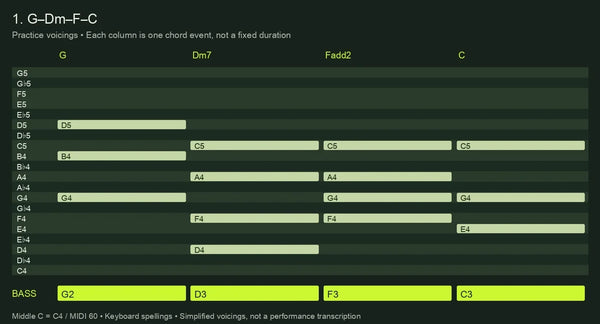
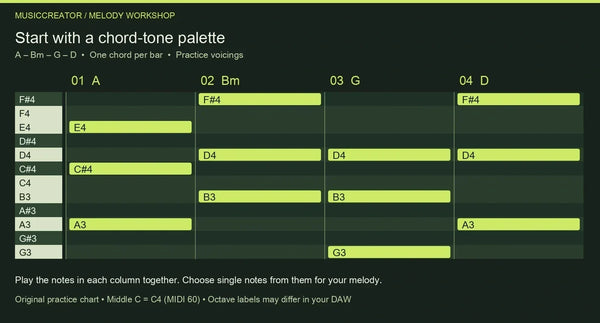
Play the bass note and upper notes in each column together. These are simplified practice voicings based on the lesson, not exact transcriptions of every octave doubling, rhythm or performance detail. One column means one chord event; choose its duration yourself. Middle C is C4 / MIDI 60 here. Some DAWs call the same note C3. The diagrams use flat keyboard spellings where your DAW may show sharps.
1. Am9–E7alt: make a two-chord loop pull back home
Start with A in the bass and C–E–G–B above it. Those upper notes form Cmaj7; together with A they make Am9. This is a useful construction shortcut: you can find a familiar seventh-chord shape and change its meaning with the bass. The B supplies the ninth, while C establishes the minor quality.

For the second chord, use E in the bass with G♯–C–D–G above. This is one specific altered dominant voicing: E7(♯5,♯9), with the fifth and ninth raised. The note chart uses the practical keyboard spellings C and G; formally those altered intervals are B♯ and F𝄪. You can enter the keyboard pitches without wrestling with double accidentals in a piano roll.
Listen to how the E chord wants to return to A minor. Its G♯ can rise to A, while D can fall to C. Those small movements give a two-chord vamp direction. The altered notes add tension, but they work best when the next chord gives them somewhere to go.
You do not need to double every note in the performance. Begin with the bass plus four upper notes shown in the chart. If the low end feels crowded, keep the bass separate and move the upper shape up an octave. Then compare a plain E7 with the altered version before deciding how much tension your track needs.

A short piano demonstration of the first two-chord idea.
Original source excerpt · 6.0 secondsLoop Am9 for one bar and E7(♯5,♯9) for one bar. Keep the rhythm identical, and record two versions: one with a soft piano and one with a short synth stab. Hear which sound leaves the altered notes clear.
2. Am7–B♭m7–Bm7–Cm7: slide one shape upward
Build Am7 from A–C–E–G. Duplicate the entire chord and move every note up one semitone to get B♭m7. Repeat for Bm7 and Cm7. Each shape has the same internal spacing, so the chord quality stays minor seventh while the roots climb chromatically.

This is parallel chord movement, often called planing. It deliberately travels outside a single major or minor scale. You are preserving a sound and moving it as a block. If your DAW offers a scale-lock function, turn it off for this exercise: forcing every note into A minor would change the chords.
The video’s progression card begins with ‘Am9’, but the drawn opening chord contains A–C–E–G, with no B. The working example here therefore uses Am7. Adding B would be a separate ninth-chord variation, and you would need to decide whether to add a ninth to each later chord too.
Once the four-chord ascent works, shorten the last Cm7 and walk back through Bm7 and B♭m7 into the next Am7. This gives the loop a return path instead of an abrupt jump from its highest point. Keep the descending events short enough that the opening still feels like the start of the phrase.
The source then drops root notes into a lower octave and chops the upper chords into a rhythmic pattern. Treat those as two separate edits. First confirm the bass follows A–B♭–B–C. Then change the timing and length of the upper notes while keeping all the pitches in each chord together.

The initial sustained MIDI example, before rhythmic edits.
Original source excerpt · 6.5 secondsCompare the chopped treatment with the sustained ascent.
Original source excerpt · 7.0 secondsDuplicate your sustained loop. On the copy, place short chord hits on a few offbeats and leave gaps between them. Compare both versions over the same kick. If the groove disappears when the drums stop, adjust the chord rhythm rather than adding another layer.
3. A–D–G–C: move an open voicing through fourths
The next idea combines a predictable bass route with an open upper shape. Start with A in the bass and E–G–B above it. The upper notes form E minor, a minor triad built on A’s fifth. The full set gives you the root, fifth, minor seventh and ninth, with no third.

There is an important naming detail here. The video calls this A9sus4, but the demonstrated keyboard and MIDI shape does not contain D, the fourth of A. A9(no3) is a more literal description of the notes. To make a full A9sus4, add D and keep C♯ out. The chart follows the demonstrated four-note shape, and you can audition the fourth as an extra colour.
Move the roots A→D→G→C. Each step is an ascending perfect fourth, or the equivalent descending perfect fifth when you bring it into a lower octave. In semitones, a fourth is five steps. The instruction to count four keys ‘in between’ describes that same distance; it does not mean moving four semitones.
Carry the same chord structure to each root: D with A–C–E; G with D–F–A; C with G–B♭–D. Notice the B♭ in the C chord. Copying the shape exactly produces it even though much of the earlier material used white keys. That note is part of the sound, not a mistake to correct to B.
Now reduce the jumps. Move individual upper notes by octaves while keeping their pitch classes. Aim for nearby destinations, especially where two chords share a note. Preserve the intended bass root as the lowest part of the arrangement; an extra low note on another track can change what the whole chord sounds like.
The source demonstrates a sustained version, a chopped rhythm and a further voice-leading edit. Learn them in that order. When you alter voicing and rhythm simultaneously, it becomes harder to tell which change improved the phrase.

The A–D–G–C example with a repeated chord rhythm.
Original source excerpt · 6.9 secondsA second source treatment for comparing register and groove.
Original source excerpt · 6.3 secondsMake an A9(no3)–D9(no3)–G9(no3)–C9(no3) loop. Then add D, G, C and F respectively as the suspended fourths. Keep the original version beside it so you can choose between the sparse and fuller sound.

Explore more house chord patterns
Use the House & Deep House MIDI Chord Pack as a starting point, then reshape its notes, voicings and rhythms with the techniques above.
Explore the chord pack →4. Cmaj9–D♭maj9–Cmaj9–B♭maj9: shift the colour around a centre
For Cmaj9, put E–G–B–D over a C bass. That is an Em7 upper shape. Rearrange it to G–B–D–E, as the lesson explores, or use the more compact practice voicing in the chart. The same notes can feel quite different when the highest note changes.

Move the whole harmony up one semitone to D♭maj9, then return to Cmaj9. The close root movement creates a brief chromatic detour. Keep the notes locked together when transposing: changing only the root would make a different chord rather than a parallel major ninth.
For the last event, try B♭maj9: B♭–D–F–A–C. The video’s card labels that destination B♭maj9(♯11). You can explicitly add E to supply the sharp eleventh; the five-note version in this guide gives you a clear starting point before that extra colour. If you add E, listen to its relationship with F rather than automatically placing the two notes next to each other.
This loop is useful for practising chromatic colour without losing your point of reference. C returns in the third slot, so the D♭ event feels like a departure you can recognise. The B♭ ending opens another route back into C. It is an option for an ending or turnaround, not a rule that every C-based track should follow.
Try the chords as long electric-piano voicings before chopping them. The source’s rhythmic treatment changes their energy substantially, but the harmonic idea survives with a single sustained hit per bar. If your melody clashes with D♭maj9, change or pause the melody at that point rather than assuming the chord must fit every C-major phrase.

The rhythmic version of the major-ninth example.
Original source excerpt · 6.9 secondsKeep a high E over the Cmaj9 events. On D♭maj9, move it to F; on B♭maj9, compare D with E. That small top-line experiment lets you hear the difference between a chord tone and the optional ♯11.
5. Cmaj7–E♭maj7–G♭maj7–Amaj7: divide the octave evenly
Start with C–E–G–B. Move the entire major-seventh shape up three semitones for E♭maj7, another three for G♭maj7, and another three for Amaj7. One more three-semitone move returns to C an octave above. Four equal minor-third steps divide the twelve-semitone octave evenly.

The repeated distance makes this easy to build in MIDI even though the chord roots look unrelated on paper. Select the whole chord before transposing and verify the top note along with the root. The result should remain a major seventh on every step; accidentally moving only some notes breaks the pattern.
A DAW may display D♯, F♯ and G♯ where the chart uses E♭, G♭ and A♭. These are enharmonic spellings: the same piano keys under different names. For this exercise, the MIDI numbers are the safest reference if your software uses different note labels or octave numbering.
This sequence is another colour-based loop rather than a conventional progression inside one key. Let the bass and a simple repeated rhythm establish continuity. Begin with a sparse melody that follows the chords; a long scale run over the entire sequence may hide the effect you are trying to learn.
To keep it usable in a track, you can fold later chords down an octave or change their inversions. Compare the dramatic rising version with a version in which the upper notes stay close together. The root pattern can remain intact even when the contour of the highest voice changes.

The sustained four-chord sequence.
Original source excerpt · 6.9 secondsWrite one four-bar sustained version exactly as shown. Duplicate it and move the top note of each later chord down an octave wherever that creates a smoother line. Choose the version that leaves more room for your melody.
6. Cmaj7–E♭maj7–Cmaj7–Fm7: return through the minor iv
The final example keeps the first two colours from the previous idea, returns to Cmaj7, and ends on Fm7. That last chord contains F–A♭–C–E♭. It is a different sound from Fmaj7, which contains A and E natural. Lowering both the third and seventh makes the intended change clear.

In a C-centred phrase, F minor is the borrowed minor iv chord: it comes from the parallel minor, C minor. Its A♭ can fall to G when the loop returns to C, while E♭ can rise to E. These small movements create an expressive return without needing a dominant chord at the end.
E♭maj7 introduces another borrowed colour earlier in the loop. You can practise Cmaj7–Fm7 by itself first, then put E♭maj7 back into the second slot. That separates the final resolution from the wider four-chord phrase and makes it easier to hear what the minor iv contributes.
The source finishes by repeating shorter MIDI notes and manipulating a synth control in Serum. Treat that as an arrangement lesson: a fixed progression can develop through articulation and timbre. You do not have to add more chord changes just because the loop has repeated several times.
Try a low-pass filter opening gradually over eight bars, then returning to a darker setting when the phrase restarts. Make small changes at first and match the output level when comparing. A brighter or louder patch can sound more exciting while making it harder to judge the underlying harmony.

The final loop in its repeated-note treatment.
Original source excerpt · 6.2 secondsAlternate the last chord between Fmaj7 and Fm7 over the same drums. Keep a copy of each, then add one slow timbral change to your preferred version. Decide whether the emotional shift comes from the chord, the sound, or both.
Turn a four-bar idea into a track
Give the bass its own job
Start with the roots from your chosen progression on a separate bass track. If the chord instrument already contains the same low notes, remove a doubling or move that part higher. Keep the kick and bass clear before adding more sustained harmony. A full piano voicing that sounds rich alone may be too dense once the arrangement fills out.
Make the rhythm repeatable
Choose a small pattern of chord attacks and repeat it long enough for the listener to recognise it. Leave some space after a strong hit. You can vary the final bar, shorten an ending, or add a pickup into the next phrase without rewriting every bar. Keep a sustained version of the MIDI so that rhythm experiments remain easy to undo.
Develop the sound without changing every chord
Try different note lengths, velocities and filter movement before adding another progression. Listen at a similar output level when comparing patches. The source’s final Serum demonstration is one example of creating motion over repeated notes; you can use an equivalent control in your own instrument.

For more on the available building blocks, explore our house MIDI pack guide. For a broader harmonic vocabulary, continue with nine piano chord progressions for producers or browse the MIDI pack collection.
Common questions
Do deep house chords have to use sevenths and ninths?
No. These examples focus on richer voicings, but a triad or a two-note part can work when the bass, sound and groove support it. Add extensions because you like the effect, not to meet a quota of notes.
Can I keep all these progressions in one scale?
Several deliberately use parallel chromatic movement. Forcing every note into one scale changes the idea. Start with the given pitches, then adapt the harmony and melody together if you want a different tonal direction.
What does “no3” mean?
It means the third is omitted. In A9(no3), the A–E–G–B shape lacks C♯. It also lacks D, so it is not a complete sus4 voicing. Adding D supplies the suspended fourth used in the fuller A9sus4 option.
Can I use a different synth or DAW?
Yes. These are note relationships, so any MIDI-compatible DAW and a suitable instrument can reproduce the harmony. Start with a clear sound; heavily detuned layers or long effects can make close intervals harder to judge.
What should I practise first?
Begin with Am7 and move the whole shape upward by semitones. Then learn Am9–E7alt for tension and resolution. Save the fourth-based open shapes and chromatic major-ninth colour for when you can identify each note and move it deliberately.

Get more fluent with the chords under your fingers
Develop the piano and chord skills behind these production ideas with Niko’s Modern Piano Masterclass.
Explore the piano course →Further reading: Open Music Theory on chord–scale relationships and modal mixture and borrowed chords. Use these as reference material as you experiment with the examples.