A good chord progression gives you a starting point. Voicing, bass movement and a few carefully chosen colour notes make it feel like your own.
These nine piano chord progressions move from simple pop loops to soulful sevenths, suspended endings and borrowed harmony. For each one, you will find a playable note chart, an explanation of the musical idea, and a short exercise you can try at the keyboard or in your DAW.
The guide is adapted from Niko Kotoulas’s full lesson below. Start with the basic chords before adding extensions. You do not need large hands or fast playing to hear the differences: enter the notes in a piano roll, slow the session down, and change one detail at a time.
Source: Niko’s original video. Its title says ten; the lesson displays nine numbered progressions, which are the nine covered here. The older giveaway and promotional announcements are not part of this guide.
A short preview of the expressive playing developed in the lesson.
Original piano excerpt · 7.5 secondsChoose a progression to practise
| Progression | Core lesson |
|---|---|
| 1. G–Dm–F–C | Added notes and clusters |
| 2. Am–F–C–G | Ninths and spacing |
| 3. Fmaj7–E7–Am9–C7 | Dominant chords that resolve |
| 4. Am–Dm–Em | Minor chords and altered tension |
| 5. Am–Dm–G–C–F | Root motion and suspension |
| 6. Dm7–G7–Em7–Am9 | Sevenths and common tones |
| 7. Dm7–Em7–Fmaj7–G13sus4 | Rising bass and G13sus4 |
| 8. C–Dm7–C/E–F | Inversions and slash chords |
| 9. C–E♭–B♭–F | Borrowed chords and colour |
Read the chord names before adding more notes
A major triad contains a root, a major third and a perfect fifth. In MIDI terms, add notes four and seven semitones above the root. A minor triad uses three and seven semitones. For C, that gives C–E–G or C–E♭–G.
Niko’s “3–2” and “2–3” shortcuts count the piano keys between successive chord tones, including black keys. They are not counts of scale steps. Counting the actual semitone distances avoids confusion when you enter notes in a DAW.
| Chord type | Example | Notes |
|---|---|---|
| Major seventh | Cmaj7 | C–E–G–B |
| Dominant seventh | C7 | C–E–G–B♭ |
| Minor seventh | Am7 | A–C–E–G |
| Minor ninth | Am9 | A–C–E–G–B |
| Added second | Fadd2 | F–G–A–C |
| Suspended fourth | Esus4 | E–A–B |
An add chord keeps the third and adds another note. A sus chord replaces the third with the second or fourth. A ninth chord normally includes a seventh as well as the ninth; an add9 chord does not require a seventh. Those small naming differences tell you which notes actually belong in the shape.
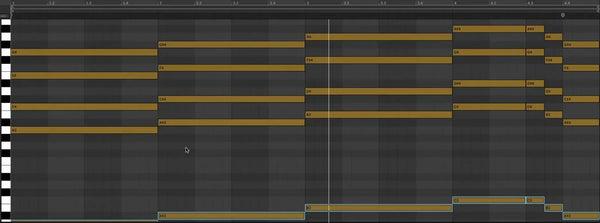
Play the bass note with the upper notes in its column. These are simplified, source-informed practice voicings, not exact transcriptions of Niko’s timing, octave doubles or embellishments. Each column is a chord event, not a fixed bar length. Middle C is labelled C4 (MIDI 60); some DAWs name the same octave differently. Flat keyboard labels may represent the same pitch as a sharp in the chord explanation.
1. G–Dm–F–C: an open pop progression
This loop starts on G, then moves through D minor and F before reaching C. All four basic triads use notes from C major. Starting away from C gives the loop forward motion without needing a complicated chord vocabulary. Treat C as the reference key for learning the shapes; the first chord of a loop does not automatically establish its key.

Play G–B–D, D–F–A, F–A–C and C–E–G first. Then add C to the D minor chord to make Dm7. On F, add G alongside the existing third, A. That produces the F–G–A–C cluster Niko demonstrates. Because A stays in the chord, this is an added-note chord, not Fsus2.
The progression stays recognisable while the inner notes make it more expressive. Put a single root or octave in the bass and keep the denser voicing higher. If the F cluster sounds too crowded, move G up an octave: the same pitch classes become a more spacious Fadd9.
Keep the bass notes fixed and alternate between plain triads and the coloured version. Choose the version that leaves room for your melody.
2. Am–F–C–G: turn a familiar loop into a richer texture
The basic Am–F–C–G loop is i–VI–III–VII in A minor, or vi–IV–I–V when heard in C major. Its familiarity makes it a useful place to practise voicing: you can hear what changes when you alter one note without losing track of the harmony.

Niko builds Am9 from A–C–E–G–B. A useful way to remember it is an A bass note underneath a Cmaj7 shape. You do not have to stack every note upward in order. Move the B into the middle, or spread C and E across octaves, while retaining the chord’s identity.
Next comes F with an added G, followed by C and a G chord coloured with C. The G–B–C–D cluster includes both the major third, B, and the fourth, C, so Gadd4 describes this version more clearly than Gsus4. The close B–C interval adds tension; move C up an octave if you want more separation.

Listen for the added-note colour and the movement between chords.
Original piano excerpt · 12.5 secondsRecord the chords as blocks, then arpeggiate exactly the same notes. Compare the change in movement before adding extra instruments.
3. Fmaj7–E7–Am9–C7: give each turn a destination
The starting idea is F–Em–Am–C. Changing Em to E major introduces G♯, and adding D turns it into E7. That G♯ is a semitone below A, so E7 creates a stronger pull toward the following A minor chord than Em does.

The final C7 supplies a second point of tension. Spell it C–E–G–B♭: Cmaj7 would contain B natural instead. When the loop restarts on Fmaj7, C7 acts as a dominant leading to F. In C-major terms, E7 is V7/vi and C7 is V7/IV. You can understand the sound before memorising those labels: each dominant points toward the next root.
Use Fmaj7 and Am9 for the softer moments between those turns. Hold common notes where possible and move only the notes that need to change. This reduces the jumping between shapes and makes the chromatic notes feel intentional rather than pasted on.

Listen to the coloured progression near the end of the third demonstration.
Original piano excerpt · 7.6 secondsPlay F–Em–Am–C, then Fmaj7–E7–Am9–C7. Listen specifically to G becoming G♯ and to the B♭ added by C7.
4. Am–Dm–Em: dark harmony with an optional altered dominant
Am–Dm–Em keeps all three chords minor. In A minor, that is i–iv–v: a useful starting point for a restrained or darker passage. The mood still depends on register, rhythm and sound choice; minor chords alone do not dictate how a track must feel.

Niko then replaces the final Em with E major and develops it into E7(♯5,♯9). The demonstrated keyboard pitches are E–G♯–C–D–G. In formal chord spelling, the raised fifth is B♯ and the raised ninth is F𝄪; the keyboard equivalents C and G are easier to locate in a piano roll. The chart uses those keyboard spellings.
This is an optional increase in tension, not a requirement for making the progression work. Try Em, then E7, then the altered version. With E in the bass, the upper G♯–C–D–G shape gives you the altered sound without having to build it from a long interval formula every time.

Resolve the altered E chord back to Am. Move G♯ up to A and let the other notes settle into nearby chord tones. Keep the plain Em ending if the stronger pull does not suit the track.

Explore more chord ideas
Try the Lofi MIDI Chord Pack with your own instruments, then reshape the notes using the same voicing techniques.
Explore lo-fi chords →5. Am–Dm–G–C–F: follow the roots through fourths
The opening roots move A–D–G–C–F. Each move is an ascending perfect fourth, or its octave-equivalent descending fifth. The chord qualities follow the surrounding key, so the result combines minor and major chords rather than moving one identical shape around the keyboard.

Niko extends the chain with Dm7, Esus4 and E major. This gives the phrase more room than a four-chord loop and creates an ending that wants to return to A minor. The suspended chord contains E–A–B. Resolving A down to G♯ changes it to E major while E and B remain in place.
That small movement is the important event. You can let the suspension last longer, resolve it on a weaker beat, or shorten it to a quick pickup. Those rhythmic decisions change the phrasing without changing the chord names.
An excerpt from the longer sequence and its suspended ending.
Original piano excerpt · 8.5 secondsPlay the eight events slowly, one bass note and a compact upper chord at a time. Give Esus4 twice as long as E, then reverse those lengths and compare the release.
6. Dm7–G7–Em7–Am9: a soulful four-chord cycle
This sequence starts with Dm7–G7, a familiar ii–V motion in C major, but continues to Em7 instead of immediately landing on C. Am follows. That keeps the loop moving and makes it useful beneath a melody that should not sound completely finished after every phrase.

The video’s progression card writes Am7, while Niko also demonstrates and discusses the added B of Am9. Both endings are useful: Am7 is A–C–E–G; Am9 adds B. Start with the simpler version, then add the ninth if it supports the top line.
Keep the upper voices close. Dm7 contains D–F–A–C, G7 contains G–B–D–F, and Em7 contains E–G–B–D. Several notes can stay in place across changes. A new bass note underneath a partly unchanged upper shape can make the harmony move without making the entire arrangement leap.
Loop the sequence with a short electric-piano sound. Remove any upper note that crowds your melody, then compare Am7 with Am9 at the end.
7. Dm7–Em7–Fmaj7–G13sus4: build with a rising bass
Here the bass walks upward through D–E–F–G. That simple contour gives the phrase direction, while seventh chords add detail above it. It can support a build or a transitional passage, especially if the rhythm remains steady while the bass climbs.

For the final chord, play G underneath F–A–C–E. Relative to G, those upper notes are the minor seventh, ninth, fourth and thirteenth. The voicing omits the third, B, and the fifth, D; G13sus4 is a useful name for the sound. Another practical label is Fmaj7/G: an Fmaj7 chord above a G bass.
The absence of B keeps the ending suspended. You can resolve to C, move to Am, or leave the phrase hanging. A suspended chord is especially useful when you want the arrangement to promise a new section without revealing its destination too early.

Hear how the upper voicing sits above the bass movement.
Original piano excerpt · 6.2 secondsPlay the last upper shape on its own, then add G in the bass. Follow it with C once and Am once. Choose the landing by ear.
8. C–Dm7–C/E–F: let the bass walk through an inversion
This progression also rises step by step, but the bass is C–D–E–F. Instead of using an E-root chord on the third step, Niko puts a C chord over E. The slash in C/E means ‘C major with E as the lowest note’; it does not mean to alternate C and E chords.

The chord’s pitch classes remain C–E–G. Changing which note sits at the bottom changes the bass line and the way the progression connects. That is the practical power of an inversion: you can preserve a familiar harmony while creating a smoother route between chords.
In a DAW, keep the bass on a separate lane or track while learning the movement. Put E below C and G for the third event, then check that no lower C from another instrument overrides it. A sub-bass playing C would change the full arrangement’s bass note, even if the piano itself plays C/E.
A short excerpt from the C–D–E–F bass demonstration.
Original piano excerpt · 6.6 secondsCompare C–Dm–Em–F with C–Dm7–C/E–F. Keep the bass line identical in both versions so you can hear the difference in the upper harmony.
9. C–E♭–B♭–F: borrow colour from the parallel minor
The final worked progression moves from C to E♭ and B♭ before returning through F. Against a C-major reference, E♭ is ♭III and B♭ is ♭VII. Both can be understood as chords borrowed from C minor. The result introduces outside notes while retaining a clear relationship to C.

Niko also explores A♭ during the explanation. Treat it as an additional borrowed-chord option, not an extra chord that must be inserted into the final four-chord loop. C major and C minor share a tonic but have different thirds, sixths and sevenths; borrowing from the parallel minor is more specific than simply moving any chord down a semitone.
Once the triads work, try E♭maj9, B♭add2 and Fmaj9. E♭maj9 is E♭–G–B♭–D–F; Fmaj9 is F–A–C–E–G. B♭add2 retains D and adds C. Notice that the extensions supply additional semitone relationships, so avoid stacking all those close intervals in a very low register.

An excerpt from the final progression demonstration.
Original piano excerpt · 8.0 secondsWrite a short melody over the plain C–E♭–B♭–F loop. Add extensions one chord at a time and keep only the colours that support the melody.
Turn the progression into a track
Separate the harmony from the performance
Start with sustained chords and a simple piano. Once the harmony works, choose how to perform it: blocks, broken chords, repeated stabs or a slow arpeggio. Keep a copy of the plain version so you can compare the musical change rather than guessing from memory.
Make room for bass and melody
Dense low chords can obscure a separate bass part. Try a single bass note underneath a higher chord, or remove the piano’s lowest doubling once the bass instrument enters. Keep important melody notes in mind when adding ninths and clusters: a colour note that sounds attractive by itself can compete with the top line.
Use one change to shape the next section
Repeat the same progression for a verse and chorus, but change its register, rhythm or final chord. Save an altered dominant or suspended ending for the point where you want the most anticipation. Leaving an earlier section simpler gives the later colour more meaning.
For another route into richer harmony, continue with our lo-fi chord progression guide. For electronic-song examples, explore these EDM piano chord progressions. You can also browse the MIDI pack collection for editable starting points.
Common questions
Do I have to use the exact voicings in the charts?
No. The charts offer one playable arrangement of each chord. Move notes by octaves, remove a doubling or simplify an extension. Keep the bass and the notes that establish the chord quality clear while you learn what each change does.
How do I transpose a progression?
Move every pitched note by the same number of semitones, including the bass and chromatic notes. Moving C-based material up two semitones puts it around D. For example, C–E♭–B♭–F becomes D–F–C–G. Do not move just the white notes or leave the borrowed chords behind.
Is E7 in the key of C major?
Its G♯ is outside the C-major scale. In the third progression, it functions as a dominant leading to Am. That brief emphasis does not require the whole song to change key.
What is the difference between an inversion and an extension?
An inversion changes which chord tone is lowest, as in C/E. An extension adds a note beyond the basic triad, such as the B in Am9. You can use both at once, but it is easier to learn their effects separately.
Why does my MIDI version sound different from the video?
The performance also includes timing, velocity, sustain, octave doubling, arpeggiation and the piano sound itself. The note charts describe harmony. They do not promise to recreate the full recorded performance.

Build the piano skills behind your productions
Develop your chord, melody and playing skills with Niko’s Modern Piano Masterclass, then bring those ideas into your own tracks.
Explore the piano course →Further reading: Music Theory for the 21st-Century Classroom: secondary dominants and Open Music Theory: modal mixture. These explain the dominant and borrowed-chord concepts used above.