Cinematic Chord Progressions
Cinematic progressions use big, open chords and bold moves that sound epic on strings and brass. Here are 10 from our Cinematic & Orchestral MIDI Chord Pack, with every chord named. Press play to hear them, then download 5 of them free as MIDI in all 12 keys.
Our packs are used by 103,468+ producers




10 Cinematic chord progressions
-
Download Free Pack
Progression 1In free pack A minor · 4 chords
AmFDmE
-
Download Free Pack
Progression 2In free pack C major · 8 chords
Csus2GBbFAbEbGsus2G
-
Download Free Pack
Progression 3In free pack A minor · 6 chords
AmEmAmDmEsus4E7(add2)
-
Download Free Pack
Progression 4In free pack C major · 4 chords
FG(add2)Am(add2)Em
-
Download Free Pack
Progression 5In free pack A minor · 4 chords
AmEmGD(add2)
Like these? Get the full pack
All 50 Cinematic progressions, including every one on this page, in all 12 keys as 3600 MIDI files. Drag them straight into FL Studio, Ableton, Logic or any DAW.
-
In the full pack
Progression 6In full pack C major · 4 chords
EFGF
-
In the full pack
Progression 7In full pack C major · 5 chords
FGAmEmF
-
In the full pack
Progression 8In full pack C major · 6 chords
Dsus2DmC(add2)F(add2)Csus2C
-
In the full pack
Progression 9In full pack C major · 5 chords
Fsus2Dm7Am(add4)AmEm7
-
In the full pack
Progression 10In full pack A minor · 6 chords
Am(add4)G(add4)GEm7Fm7Bb(add2)
What are cinematic chord progressions?
Cinematic chord progressions are written to sound big. Film composers use simple major and minor chords voiced across a whole orchestra, plus open suspended chords that hang in the air without resolving.
The drama comes from bold moves: major chords a 3rd apart, a major IV chord inside a minor key, and slow loops that build by adding instruments rather than by changing chords.
What makes a progression sound cinematic
We counted every chord and every chord change in the 50 progressions of our Cinematic & Orchestral MIDI Chord Pack, 269 chords in all. These are the patterns that make them sound cinematic, and why they work.
01The chords
21% are suspended chords
Sus2 and sus4 chords have no 3rd, so they sound vast and unresolved. In our pack they are as common as minor chords.
A suspended chord has no 3rd, so it's neither major nor minor. Held on strings or a pad, it sounds vast and unresolved, which is why film composers love it.
Plain major chords are the most common chord in the pack (45%), then suspended chords (21%).
Csus2
C · D · G
Root, 2nd and 5th, with no 3rd. Open and unresolved: neither major nor minor.
02The moves
31% of the changes move up a fifth
Like Am to Em or F to C. It is the strongest change there is, and nearly a third of the moves in our pack are this one.
12% of the changes jump up a minor third
Like F to A♭. A jump to a major chord three half steps up is the bold, heroic shift you hear in film trailers.
Moving up a 5th is the strongest change in music. Jumping up a minor 3rd to a major chord, like F to A♭, is the bold shift behind many heroic film themes.
Am → Em
Up a 5th
The bass climbs a 5th, A to E. On top, E stays put. C slides down a half step to B. A steps down to G.
5 cinematic chord progressions every producer should know
-
i–v–VII–IV A minor
AmEmGD
The Inception progression. The major IV at the end sounds hopeful inside a minor key.
-
I–♭VI C major
CAbCAb
Two major chords a major 3rd apart. The classic heroic, wide-screen shift.
-
i–VI–III–VII A minor
AmFCG
The epic minor loop. Trailers and video games build on it again and again.
-
I–♭III–IV–I C major
CEbFC
The ♭III, borrowed from minor, gives a bold, triumphant lift.
-
i–iv–i–V A minor
AmDmAmE
Minor with a major V. Dramatic and old-world, like a classic score.
Famous songs that use cinematic chord progressions
-
Time Hans Zimmer (from Inception) · A minor
AmEmGD
i–v–VII–IV, repeated as the orchestra builds around it.
Take them into your DAW
All 50 progressions as 3600 MIDI files, in all 12 keys.
$27$47
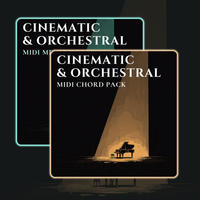
5 progressions in all 12 keys, 360 MIDI files. Free with your email.
Free
Download Free PackAlso free: Cinematic & Ambient Free MIDI Chord Pack
How to write your own cinematic chord progression
-
1
Use a major IV in minor
In a minor key, play the IV chord as major, like D in place of Dm in A minor.
Why it worksD major has an F♯, a note that isn't in A minor. That one raised note makes the progression sound hopeful and heroic, the Dorian colour of the Inception theme.
AmEmGDm
AmEmGD
-
2
Shift by a major 3rd
Move between two major chords a major 3rd apart, like C and A♭.
Why it worksC and A♭ share one note, C, while the others move by a half step: E down to E♭ and G up to A♭. That shift is the classic heroic, wide-screen film-score move.
CCFF
CCAbAb
-
3
Open it up with sus2 chords
Swap major chords for sus2 chords, like Csus2 and Fsus2.
Why it worksSus2 chords drop the 3rd, so they're neither major nor minor. Held on strings or pads, they sound vast and unresolved.
CFCG
Csus2Fsus2Csus2G
-
4
Spread it across the orchestra
Voice the chords wide, from a low bass note up to high strings.
Why it worksOrchestras spread chords across cellos, violas and violins. Wide voicings like these sound huge, even on a single piano.
AmFCG
AmFCG
Questions
Can I use these cinematic chord progressions in my own songs?
Yes. Chord progressions can't be owned, and every MIDI file we make is royalty-free, so you can release and sell music made with them without crediting us.
What is the most common cinematic chord progression?
i–v–VII–IV. In A minor it's Am – Em – G – D. The Inception progression. The major IV at the end sounds hopeful inside a minor key.
What songs use cinematic chord progressions?
Time by Hans Zimmer (from Inception) (Am – Em – G – D). You can hear each one in the famous songs section above.
How do I get them into FL Studio, Ableton or Logic?
Download the ZIP, unzip it and drag any MIDI file onto an instrument track. It works in every DAW that opens MIDI, including GarageBand, Cubase, Studio One and Reason.
What key are they in?
This page plays each progression in C major or A minor. The free download and the full pack have every progression in all 12 keys, so you can pick the one that matches your song.
What makes a chord progression sound cinematic?
In our cinematic pack, 21% are suspended chords; 31% of the changes move up a fifth; 12% of the changes jump up a minor third. The section above explains what each one does.
What if the pack isn't right for me?
Every paid pack comes with a 30-day money-back guarantee. If it isn't for you, email us and we'll refund you.
Free MIDI download
Get 5 of these free
5 Cinematic progressions, each with 5 rhythm versions, in all 12 keys. 360 MIDI files, ready to drag into your DAW.
Your download is ready. We've also added you to our free packs emails.